




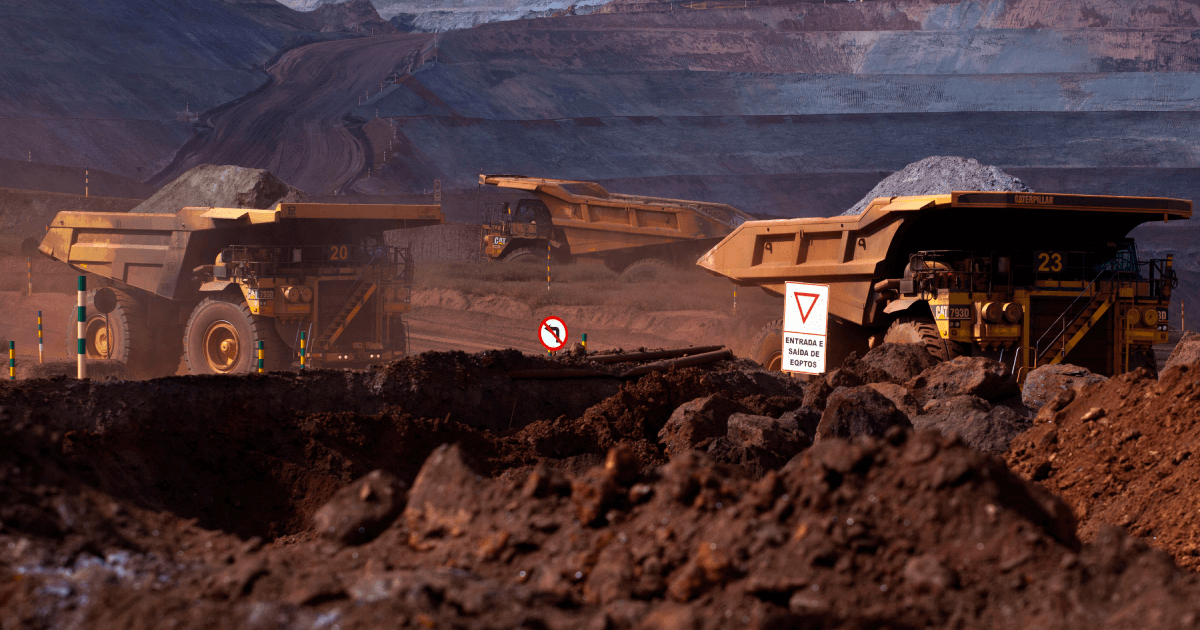
Boosting sales to India and other Asian markets will help offset stagnant demand from China
Brazilian mining company Vale is preparing to meet growing demand for iron ore from India, which could double its steel production by the end of the decade. This was stated by the company’s CEO Gustavo Pimenta in an interview with Reuters.
In his opinion, increased sales to India and other Asian markets will help offset stagnant demand from China, where steel production has remained at around 1 billion tons in recent years and may decline slightly.
“India has a population of 1.6 billion, has already overtaken China, and needs large-scale investments in infrastructure — and therefore a large amount of steel,” Pimenta said.
He estimates that Indian steelmakers’ capacity will double to 300 million tons in the next 5-7 years.
India is importing about 10 million tons of Vale ore this year, whereas a few years ago there were almost no such deliveries. Although this is a small share compared to China, which accounts for about 60% of the company’s sales, Vale sees India as the main source of future growth.
“Our high-quality concentrate blends perfectly with Indian raw materials, creating synergy for both markets,” Pimenta said.
Vale also expects demand to grow in Vietnam, where sales are expected to increase to 8 million tons in 2025.
Pimenta said Vale is investing R$70 billion ($13 billion) in the Novo Carajas program in Brazil, which will increase ore production capacity by 20 million tons per year. The project is already 80% complete and is expected to launch in late 2026. The company also plans to double its copper production by 2035.
Against the backdrop of expansion, Vale expects to regain its status as the world’s largest iron ore producer, overtaking Rio Tinto, which took the top spot after the Brumadinho dam disaster in 2019.
As a reminder, at the end of 2024, Vale achieved its highest iron ore production level since 2018 – 327.67 million tons, which is 2% more than a year earlier. Pellet production increased by 1.2% y/y to 36.89 million tons. At the same time, in the fourth quarter, production decreased by 4.6% y/y – to 85.28 million tons, and pellet production decreased by 6.9% y/y – to 9.17 million tons.
-

Opinions Industry macroeconomics
28 May 2026
04 June 2026

03 June 2026

03 June 2026