


News Global Market EU 5236 28 October 2025
Analysts predict that wholesale prices will depend on weather conditions in winter
European gas prices in October 2025 (October 1-24) ranged from €31-33/MWh.
The highest price for TTF futures for the month ahead on the ICE exchange was recorded on October 7 at almost €33.25/MWh. This was driven by forecasts of lower-than-normal temperatures in November and, consequently, concerns about insufficient levels of European gas storage.
The market also reacted with some price increases to the EU Council’s decision to approve a plan to abandon Russian gas, according to which a complete ban on its imports, including LNG, will come into effect on January 1, 2028.
In addition, prices rose after the EU adopted the 19th package of sanctions against Russia, banning LNG imports from 2027, a year earlier than in the roadmap proposed by the EC. However, this growth was limited.
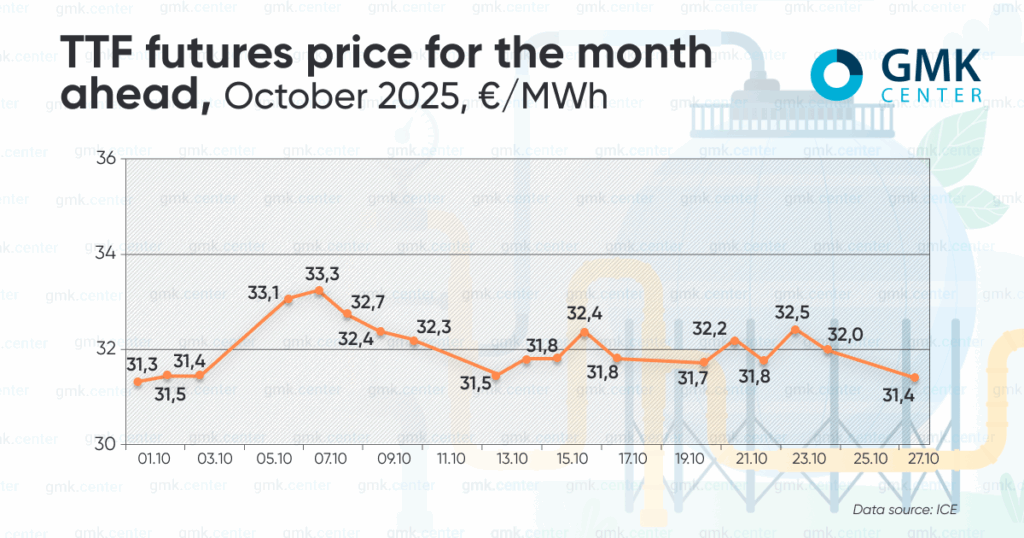
However, according to analysts at the multidisciplinary brokerage firm VT Markets, the jump in European gas prices to €33/MWh is a sign that the market is shifting its focus to winter supply risks. Forecasts of colder weather are forcing the heating season to start early. This is creating the appropriate mood and influencing the revaluation of short positions. Risk factors remain lower than usual levels of stocks in European gas storage facilities over the past few years (as of October 26, it was almost 83%) and possible reductions in supplies from Norway. Therefore, unplanned supply disruptions or prolonged cold weather will affect prices.
ICIS experts have also warned about the impact of weather on prices. In their opinion, wholesale gas prices may vary significantly in the event of a cold or mild winter due to the dynamics of the global LNG market and competition from Asia.
However, even extremely low temperatures this winter are unlikely to cause a gas shortage in Europe, analysts say. In the most extreme scenario considered by ICIS, storage reserves could be depleted by up to 20% (the last time such a level was observed was in 2018). However, next summer, the LNG market expects new capacities to come online, so significantly depleted reserves will not necessarily be a problem.
It should be noted that electricity prices in Europe fluctuated in September due to seasonal factors, depending on the volume of generation from renewable sources, growth in demand due to weather conditions, changes in gas prices, and carbon emissions. The futures price of the Dutch TTF (November contract) in September, according to the ICE exchange, was in the range of €31-33/MWh.