




News Global Market gas prices 165 22 July 2026
The market is under pressure from the renewed escalation in the Middle East
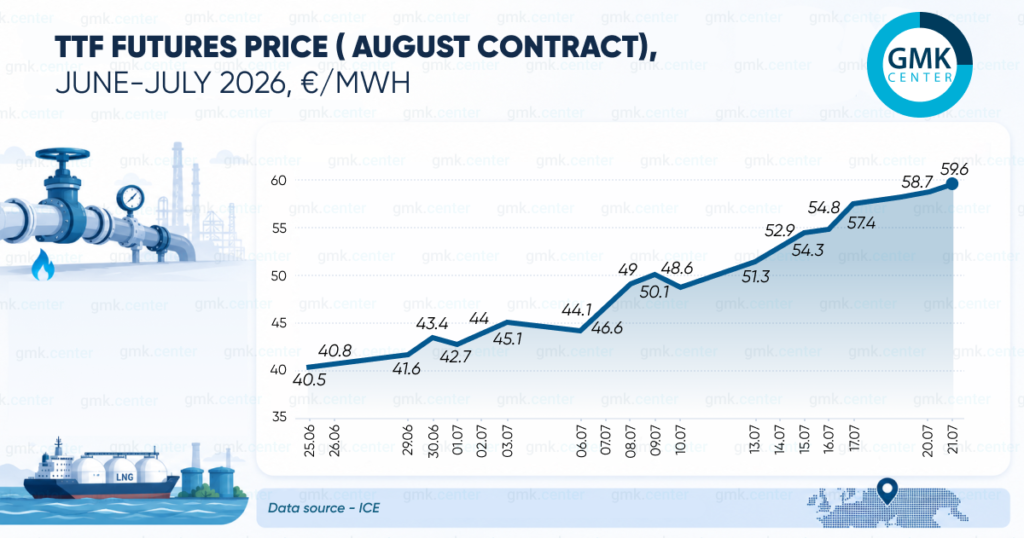
European gas prices had been above €50/MWh since mid-July, and by the second ten-day period of the month they had already risen to over €60/MWh.
In June, the average price of TTF gas futures for the following month stood at €44.94/MWh — this was driven by increased supply availability compared with May and an easing of tensions in the Middle East. However, as early as the beginning of July, according to ICE data, European gas contracts began to rise in price against the backdrop of renewed hostilities between the US and Iran.
Prices continued to rise thereafter. In particular, on 20 July, the price of TTF gas futures briefly rose to €60/MWh, approaching the peak price observed at the start of the conflict in the Middle East. During intraday trading on 22 July, it had already risen above €62/MWh (August contract).
At present, the European market is under pressure not only from the availability of Qatari LNG, but also from rising freight and insurance costs in the region. Furthermore, competition for spot shipments of liquefied natural gas remains fierce. In particular, US LNG exporters are increasingly channelling their supplies to Asia due to higher prices there. As a result, European buyers are having to pay more to secure additional gas volumes.
Evan Tan, an LNG analyst at Independent Commodity Intelligence Services (ICIS), quoted by Bloomberg, notes that if geopolitical tensions persist over the next few months, gas shortages in European storage facilities and steady demand in Asia will mean that both regions will drive spot prices upwards by the end of the year.
As of 21 July, European gas storage facilities were 54.2 per cent full (compared with 65 per cent on the same date in 2025). The slow filling of gas storage facilities during the critical summer season poses a risk to the region not only of failing to reach the 80 per cent target by the start of winter, but also of significantly increasing the costs of achieving these targets.
ICIS, as reported by The Guardian, forecasts that if the price of gas remains at around €60/MWh, this could necessitate potentially costly state intervention to ensure security of supply. However, ICIS modelling suggests that European gas storage facilities may still reach their targets by the end of November.
However, in a statement issued on 13 July, the EU Working Group on the Energy Union noted that, although prices remain higher than pre-conflict levels in the Middle East, volatility is relatively low and gas prices are significantly lower than those seen during the 2022 energy crisis. This state of affairs currently reflects uncertainty regarding the duration of the conflict and the current situation on the global market.
The statement also notes that there are no immediate grounds for concern regarding security of supply for the winter of 2026–2027, as the targets for filling storage facilities remain achievable before the start of the winter season. Furthermore, the EU’s significant spare capacity for LNG imports is expected to provide additional flexibility to meet winter demand and facilitate the optimal use of storage facilities.
It should be noted that European gas prices in the second half of June stood at €40–42/MWh. Despite the fall in prices, the market remains sensitive to developments in the Middle East.
-

Opinions Industry steel consumption
13 July 2026

22 July 2026
22 July 2026

22 July 2026