





News Global Market Ціни на викиди CO2 2652 14 May 2026
The market is reacting to news about the conflict in the Middle East and the European Commission's announcement
According to ICE, futures prices for CO2 emission allowances (EUA, December 2026 contract) reached €74–77/t in May, matching the levels seen in the second half of April.
Last month, the average monthly price was €74.04/t, which is 5.7% higher than in March.
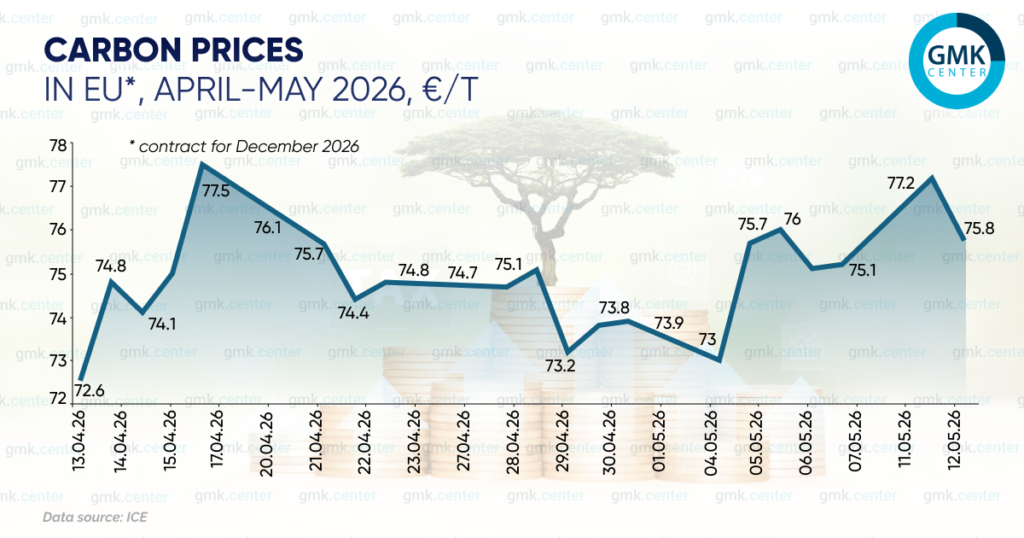
In May, the European carbon market was influenced by volatile energy prices, news regarding the situation in the Middle East, and expectations surrounding the revision of the European emissions trading system. For example, on May 6, the price of EUAs rose to €76/t compared to €73/t at the start of the week (May 4). As Carbon Pulse notes, traders likely reacted to leaked proposals indicating that the benchmarks for free allocation of allowances would not change significantly from the previous trajectory.
At the same time, in late April, ten analysts surveyed by Reuters significantly lowered their forecasts for prices in the EU carbon market for the next few years. They expect the price of emission allowances to average €80.61/t in 2026 and €93.29/t in 2027. In January, the forecasts were €92.65/t and €107.29/t, respectively.
According to experts, price dynamics this year will be largely shaped by changes in the supply of allowances driven by policy measures, a reduction in speculative positions by market participants, and rising expectations of further regulatory intervention.
On May 11, the European Commission presented updated EU ETS reference values for 2026–2030—the proposal is open for public consultation and discussion with member states prior to adoption.
The document provides for the allocation of a greater number of free allowances to industry over the next few years, which could potentially save companies €4 billion in CO2 emissions costs. On average, free allowances will cover about 75% of the industrial sector’s emissions.
The update to the benchmarks complements the proposed amendment to the EU ETS Market Stability Reserve, which was presented on April 1. In addition, a broader review of the EU Emissions Trading System is scheduled for July 2026 with a view to its further modernization.
On May 7, the European Commission, on behalf of the EU, together with Brazil and China, officially launched an open coalition on carbon market compliance. According to the institution’s statement, the initiative will provide a platform for cooperation on developing and strengthening domestic carbon markets and carbon pricing policies.
Efforts will focus on key elements (reliable monitoring, reporting, and verification systems; sound carbon accounting methodologies, etc.). The coalition is open to countries with eligible national carbon markets, such as emissions trading systems or a carbon tax. New Zealand and Germany were the first countries to join. Brazil will chair the coalition for the first two years, with China and the European Commission serving as co-chairs.
As a reminder, in the second half of April, the market reacted, among other things, to political statements, and prices often fluctuated in directions opposite to the dynamics of energy price changes.
-

Opinions Industry macroeconomics
28 May 2026
03 June 2026

03 June 2026

03 June 2026