





GDP impact could be higher, depending on changes in the post-war structure of Ukraine's economy
The EU Carbon Border Adjustment Mechanism will impose significant losses on the Ukrainian economy, with GDP declining by 2.1% by 2030 solely from reductions in iron and steel, incl. supply chains, according to a comprehensive study by GMK Center. This projection stands in stark contrast to the European Commission’s estimate of a -0.01% GDP impact. This is outlined in a comprehensive study by the GMK Center, which can be downloaded via the link.
The analysis reveals a sharply deteriorating situation in 2029-2030, as the tariff burden increases to 26% in 2030 from 12% in 2026. GMK Center forecasts a complete halt in Ukrainian exports of long products and square billets by 2030, alongside a 75% reduction in pig iron exports and a 30% decline in flat-rolled product exports. This could result in the idling of three blast furnaces at two major long products plants. Total export losses are projected at $1.75 billion by 2030.
GMK Center’s analysis highlights the discriminatory character of CBAM for lower-income countries unable to afford state subsidies for large-scale decarbonization. CBAM further undermines the investment capacity of Ukrainian steel enterprises, which are already facing a deficit of investment resources. Cumulative CBAM payments for Ukrainian iron and steel exports during 2026-2030 could reach €1.2 billion – equivalent to the entire capital expenditure of Ukrainian steel mills over two years, compared with $650 million invested in 2024.
Beyond direct economic losses, CBAM threatens to disrupt established supply chain cooperation between Ukrainian and EU businesses. The integrated operations of Ukraine’s Kametsteel plant and Bulgaria’s Promet Steel exemplify this risk, with the Ukrainian facility supplying billets for rebar production in Bulgaria, placing EU jobs in jeopardy.
The Ukrainian economy will be unable to offset up to $2 billion in annual exports, $0.9 billion in capital expenditure and $1.6 billion in tax revenues lost to CBAM through other sectors, given the scarcity of business models operating at such scale in the country, according to GMK Center estimates.
GDP losses could exceed the projected 2.1% by 2030 depending on the structure of the post-war economy. At present, Ukraine’s GDP is sustained by military expenditure financed by international partners, with the share of defense spending exceeding 43% of GDP. Any reduction in such spending would trigger an economic contraction, making the $6 billion in CBAM-related losses, incl. supply chain effects, a critical additional burden.
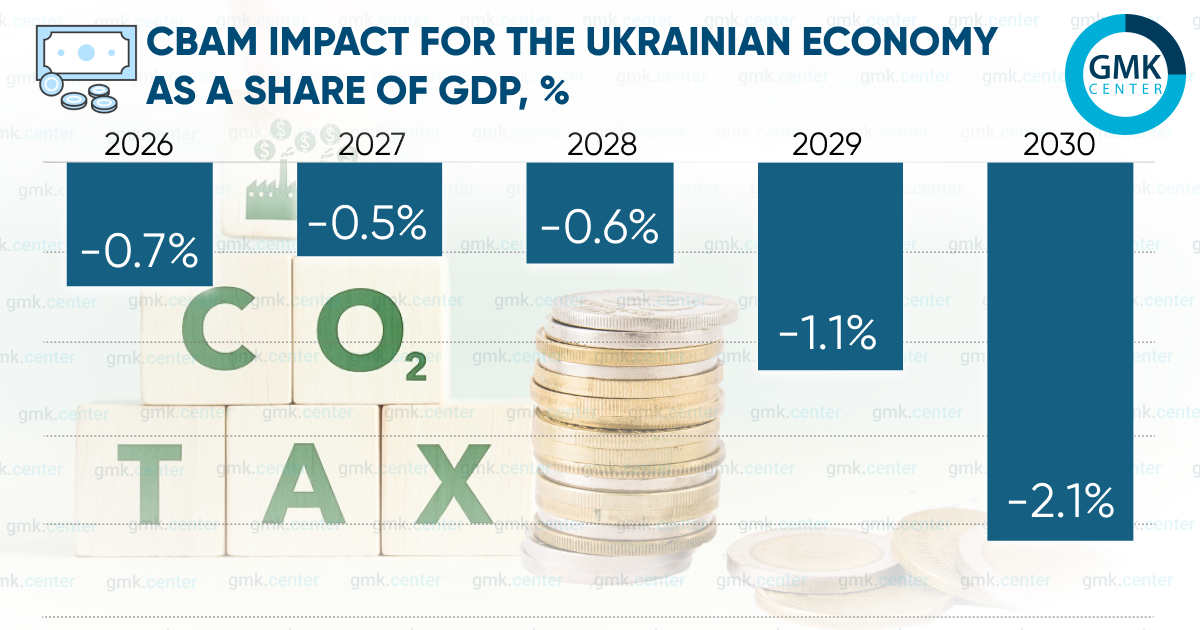
The analysis concludes that preserving Ukraine’s iron and steel industry requires a revision of the European Commission’s assessment of Ukraine’s losses from CBAM, with the aim of resuming dialogue on deferring obligations for Ukraine, as well as a discussion of new mechanisms for financing decarbonization projects with EU participation, ensuring the sector’s survival while maintaining its strategic value for European supply chains.
As reported by GMK Center, Montenegro’s annual expenditure on the European Carbon Border Adjustment Mechanism (CBAM) could amount to €191 million.
-
Opinions Industry steel consumption
13 July 2026
27 July 2026

25 July 2026
23 July 2026