




News Global Market pig iron prices 222 18 June 2026
Prices in most regional markets remained stable over the same period
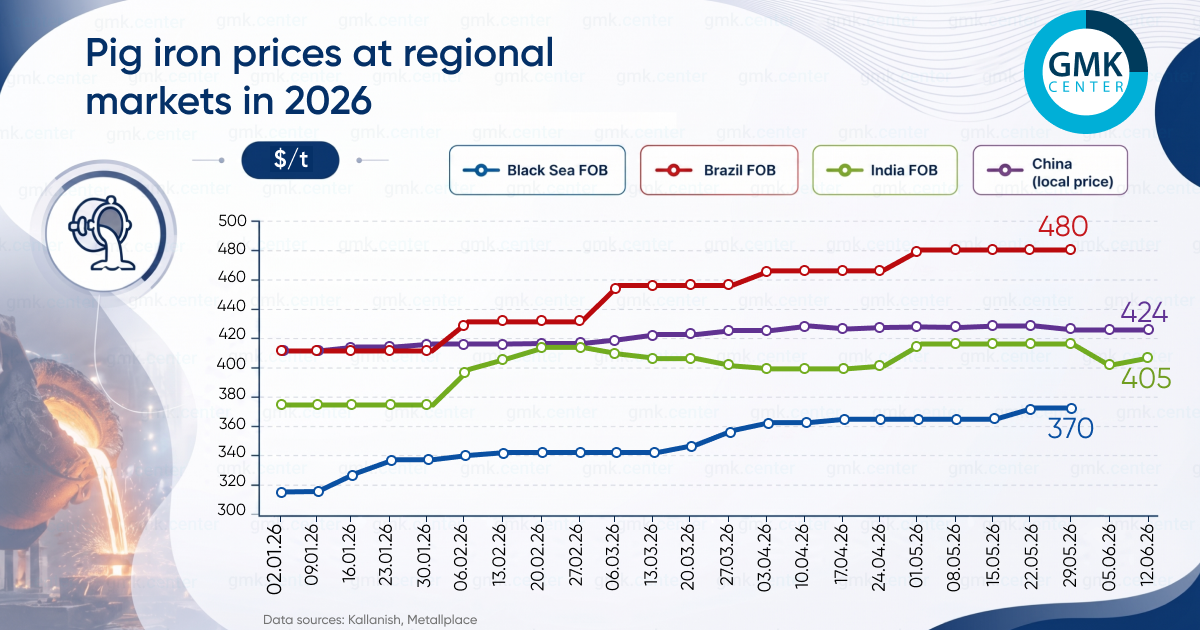
Average prices for pig iron remained largely stable in most regional markets during the first half of June. In Brazil, average quotations for the period ranged from $495 to $500/t (FOB).
Brazil
Prices for Brazilian pig iron remained stable in the first half of June. According to Platts, over the last three weeks, quotations for pig iron from south-eastern Brazil fluctuated between $495 and $500/t on FOB terms.
During the first half of the month, the Brazilian pig iron market was at a standstill due to additional US tariffs imposed for unfair trade practices (25 per cent) and forced labour (12.5 per cent). The market was dominated by considerable uncertainty and concern over a possible decline in the competitiveness of Brazilian pig iron.
The US is a key export destination for Brazilian pig iron. Last month, the country shipped 161,000 tonnes of pig iron to the US (on FOB terms) at a price of $444 per tonne. For January–May, this volume has already reached 1.2 million tonnes. For the whole of last year, shipments totalled 3.4 million tonnes, or 83 per cent of Brazil’s total pig iron exports.
Negotiations between the two countries, during which the granting of an exemption from additional duties for Brazilian pig iron is to be discussed, are of paramount importance for future Brazilian pig iron exports to the US. At the same time, there is significant interest in Brazilian pig iron in the US due to its competitive price and the use of charcoal by independent producers, which ensures virtually zero CO₂ emissions.
Overall, according to data from SECEX (the Foreign Trade Secretariat of Brazil’s Ministry of Development, Industry and Foreign Trade), Brazilian pig iron exports rose by 5% month-on-month in May to 280,000 tonnes. The increase was driven by a recovery in exports to Europe, to which Brazil shipped 86,000 tonnes at $438 per tonne.
Turkey
In mid-June, average pig iron prices (on a Black Sea FOB basis) fell under pressure from scrap and low demand.
The Turkish pig iron market remains extremely volatile. According to the Turkish Statistical Institute (TUIK), in April this year, pig iron imports into Turkey fell by 16% month-on-month (following a 42% month-on-month increase in March), to 201 thousand tonnes. Over the first four months of this year, pig iron imports into Turkey rose by 22% year-on-year to 812,000 tonnes. Russia was the largest supplier during this period, supplying 750,000 tonnes of pig iron (+42% year-on-year) with a market share of 91%.
Against the backdrop of volatility in pig iron imports, domestic production in Turkey rose sharply. According to WorldSteel, pig iron output in April increased by 19% year-on-year to 0.9 million tonnes. Over the first four months of this year, the figure rose by 17.5% year-on-year to 3.6 million tonnes.
China
According to SteelOrbis, domestic pig iron prices in China (including 13% VAT) for this period stood at $424/t. Over the first five months of this year, pig iron production in China fell by 3.1% year-on-year to 355 million tonnes. At the same time, in May, the figure rose by 3.2% month-on-month compared with April to 73 million tonnes.
India
According to Metallplace, prices for pig iron on the Indian market fell by $10 over the first two weeks of June, to $405/t (FOB). Although India is not one of the key pig iron exporting countries, exports of this product have risen sharply since April this year due to strong demand from the US and other countries. In April–May, the US became the main destination for Indian pig iron exports, with volumes of around 250,000 tonnes. The reasons for this increased appeal lie in competitive pricing compared with other exporters, a reduction in US tariffs on imports from India, and higher scrap prices, which have made purchasing pig iron more profitable.
Overall, pig iron exports from India do not yet pose significant competition to suppliers such as Brazil. In the 2026 financial year, pig iron exports from India more than doubled – reaching a total of 0.61 million tonnes. At the same time, domestic production remained largely stable – 8.4 million tonnes in the 2026 financial year compared with 8.3 million tonnes in the 2025 financial year.
As previously reported, global pig iron production in January–April 2026 fell by 1.6 per cent compared with the same period in 2025, to 456 million tonnes. The largest pig iron-producing countries for this period were China – 282.3 million tonnes (–3.1% year-on-year), India – 53.5 million tonnes (+5.4% year-on-year) and Japan – 19.21 million tonnes (–1.8% year-on-year).
-

15 June 2026

18 June 2026

18 June 2026

18 June 2026