




News Global Market DRI 1798 18 July 2025
This figure was influenced by the almost complete cessation of imports by Germany and the Netherlands
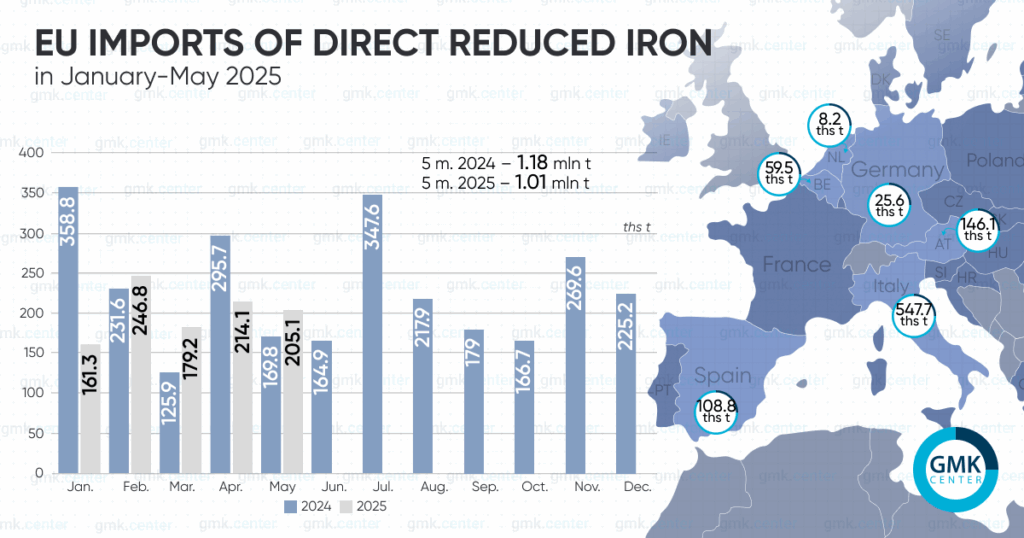
In January-May 2025, the European Union reduced imports of direct reduced iron (DRI) by 15.8% compared to the same period in 2024, to 1.01 million tons. This is evidenced by GMK Center calculations based on Eurostat data.
The main importers of direct reduced iron among EU countries in the period were Italy, Spain, and Austria, in particular:
- Italy – 547,740 tons (+77% y-o-y);
- Austria – 146.08 thousand tons (+29% y-o-y);
- Spain – 108.81 thousand tons (+3.9% y-o-y).
The almost complete cessation of imports by Germany and the Netherlands had a negative impact on import volumes. In particular, 304.57 thousand tons of DRI were shipped to the German market in January-May 2024, while this year only 25.62 thousand tons were shipped, and 122.06 thousand tons were shipped to the Dutch market compared to 8 tons in the first five months of 2025. At the same time, a sharp increase in imports by Italian metallurgists and moderate growth in demand from other key consumers limited a deeper decline in the indicator.
Russia is the largest supplier of DRI to the European Union. In January-May, Russian companies shipped 353,190 tons of direct reduced iron to European consumers, which is 3% less than in the same period last year.
The main importers of Russian products are Italy (212,450 tons, down 27.8% year-on-year) and Poland (54,990 tons, up 8.1% year-on-year). Belgium and Italy each imported 42,000 tons of DRI.
Libya shipped 156.52 thousand tons of DRI to the EU in five months, reducing the figure by 8.8% y-o-y. Venezuela exported 272.26 thousand tons of the corresponding products to the European Union (+4.2 times y-o-y). Supplies from Venezuela are recording significant growth, indicating a reorientation of supply chains. In 2023, 133 thousand tons of DRI were imported from this direction, and in 2024 – 293.98 thousand tons. The US sent 166.02 thousand tons of products to the EU (+0.3% y-o-y).
In May, the EU imported 205,090 tons of DRI, which is 20.8% more y-o-y, but 4.2% less m-o-m.
Russia exported 111,850 tons of raw materials to the EU during the month (+17.3% y-o-y; +103.2% m-o-m) – the highest since April 2024, Libya – 56.71 thousand tons (+60.1% y-o-y; +5.1 times m-o-m). Venezuela did not supply DRI to the EU, while the US increased its exports by 31.3% y-o-y and 16% m-o-m, to 31.02 thousand tons.
As GMK Center reported earlier, at the end of 2024, the EU increased imports of direct reduced iron from third countries by 5.4% compared to 2023, to 2.75 million tons. In 2023, there was an 11.1% y-o-y decline. The largest importers of DRI among EU member states last year were: Italy – 659.73 thousand tons (-23.7% y-o-y), the Netherlands – 527.27 thousand tons (+423%), Germany – 438.46 thousand tons (-33.5%).
The key suppliers of DRI to the EU in 2024 were traditionally Russia, Libya, the US, Venezuela, and Canada. These countries account for about 85% of raw material supplies to the bloc, with Russia accounting for 38%.
-

Opinions Industry steel consumption
13 July 2026
24 July 2026

24 July 2026
24 July 2026