




News Global Market Germany 441 21 July 2026
In June, the figure rose by 9.5% y/y
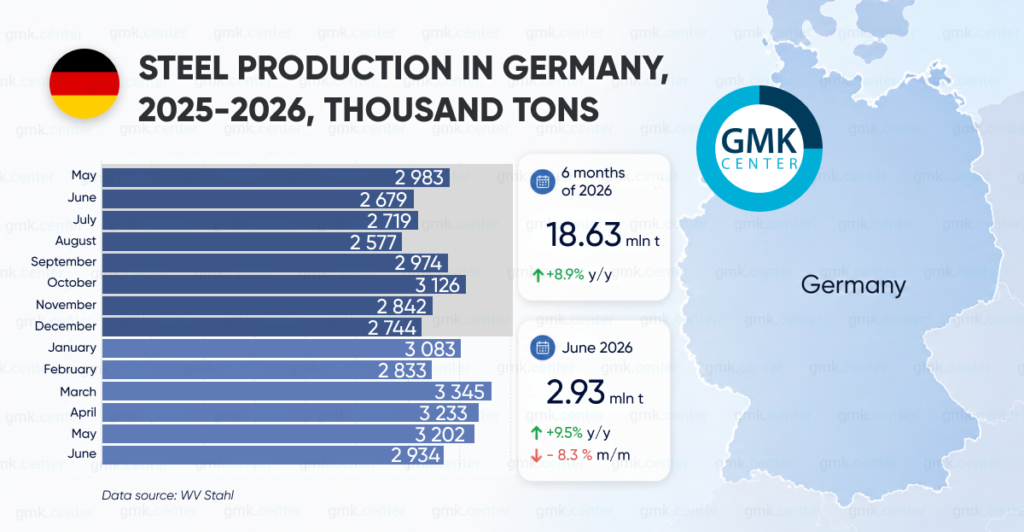
In the first half of this year, Germany increased its steel production by 8.9% year-on-year – to 18.63 million tonnes. This is according to figures from the country’s Steel Industry Association (WV Stahl).
Between January and June, 12.76 million tonnes of steel were produced in basic oxygen furnaces, an increase of 11.5% year-on-year. Steel production in electric arc furnaces for the period totalled 5.87 million tonnes, up 3.5% compared with the first half of 2025.
Pig iron output in the first half of the year stood at 11.62 million tonnes (+9.3% year-on-year), whilst hot-rolled steel output was 16.1 million tonnes (+5.4% year-on-year).
In June alone, German steelmakers produced 2.93 million tonnes of steel, which was 9.5% higher year-on-year, but 8.3% lower than in the previous month. Steel production in basic oxygen furnaces for the period stood at 1.9 million tonnes, and in electric arc furnaces at 1.03 million tonnes.
Pig iron output in June stood at 1.73 million tonnes (+6.3% year-on-year, –11.5% month-on-month), whilst hot-rolled steel output was 2.7 million tonnes (+8% year-on-year, +1.6% month-on-month).
However, WV Stahl notes that, despite the positive developments of recent months, it is still too early to speak of a full recovery. At present, annual steel production will amount to just 37.7 million tonnes, remaining below the 40-million-tonne threshold considered necessary for the economically viable utilisation of production capacity.
The industry association noted that the extremely low level of demand for steel in the country remains a serious problem. The main consumer sectors — construction, mechanical engineering and equipment manufacturing, as well as the automotive industry — posted weak results for the first half of the year.
According to Kerstin Maria Rippel, CEO of WV Stahl, the rise in production is mainly due to technical factors, in particular restocking.
“Production figures are rising, but a genuine recovery will only begin once real demand for steel picks up,” she explains.
The CEO of WV Stahl added that the steel industry remains in a difficult situation.
In addition to weak demand in the first half of 2026, the EU steel market was also under significant pressure from imports. The industry association highlighted the importance of the bloc’s new protective mechanism for steel.
“It ensures that the future recovery in demand will actually translate into higher capacity utilisation at steelworks in Germany and other EU Member States,” notes Kerstin Marie Rippel
However, additional demand stimuli, in particular public procurement, are needed to kick-start a sustainable economic recovery. Furthermore, the association considers it crucial to create the conditions to retain industrial production in Germany – which is why competitive electricity prices are essential.
It is worth noting that, in 2025, Germany had reduced its steel output by 8.6% compared with 2024 – to 34.09 million tonnes.
-
Opinions Industry steel consumption
13 July 2026
21 July 2026
21 July 2026
21 July 2026