





News Global Market Ціни на викиди CO2 3060 21 June 2026
The market is reacting to political decisions and expectations regarding ETS reform
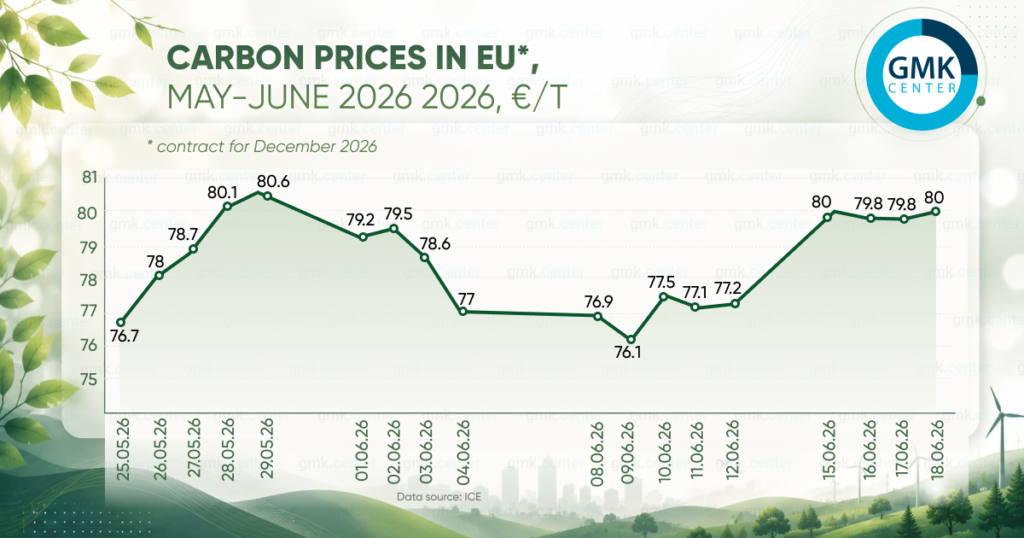
European carbon prices (EUA, December 2026 contract), according to ICE, rose to €80/t in June.
The market reacted to a breakthrough in negotiations between the US and Iran, which is expected to put downward pressure on energy prices, as well as to the announcement of the UK–EU summit on 22 July: an agreement on the merger of the UK ETS and the EU ETS is expected to be concluded during the summit.
Prices had already reached these levels at the end of May against the backdrop of announced regulatory changes regarding carbon emissions in Europe and expectations of an agreement between Tehran and Washington.
By the end of this week (19 June), auction prices continued to hold above €80/t, as the market awaited clarity on the ETS reform and the terms for the reopening of the Strait of Hormuz.
In mid-June, the European Commission confirmed that in July this year it would present a separate proposal setting out additional benchmarks for certain industrial sectors regarding an increase in their free allowances, as well as a review of the bloc’s carbon market.
The EU plans to grant industry additional free CO₂ emission allowances this year to help companies cope with international competition, Reuters reports, citing European diplomats and a draft set of conclusions for the bloc’s leaders’ summit. However, the agency notes that this move could allow companies to increase their emissions. The plan comes in response to pressure from a number of countries, such as Italy, Poland and the Czech Republic.
European steelmakers — ArcelorMittal, Thyssenkrupp Steel and voestalpine — in turn called in June for pragmatic reforms to the emissions trading system.
In a joint statement, the companies noted, in particular, that under the current ETS system, the cost of steel production in the EU is expected to rise by approximately 50 per cent by the early 2030s, placing significant pressure on the sector. It was also noted that imported steel-intensive products are not subject to equivalent carbon costs, whilst European steel exports from the EU do not benefit from any mechanism to offset carbon costs. Consequently, the sharp rise in costs under the emissions trading scheme will have a negative impact not only on steel production but also on the entire value chain.
Steel producers believe that the EU ETS must be aligned with the realities of industrial transformation; in particular, a temporary pause in the rise of carbon costs is needed until economically viable conditions for decarbonisation are established.
European chemical companies are also calling for a halt to the rise in carbon costs.
Meanwhile, a group of investors managing assets worth around €12 trillion has previously called on EU leaders to protect the emissions trading system from pressure to lower prices and not to water it down. They highlighted the points that should be retained during the review, in particular ensuring that the cap aligns with the bloc’s climate targets, limiting price volatility and ensuring market liquidity.
It is worth recalling that European carbon prices in the second half of May stood at €75–79/t. Overall, market dynamics throughout the month were driven by volatility in energy prices due to the conflict in the Middle East, discussions regarding the reform of the EU ETS, and expectations of changes to the free allocation of allowances to industry.
-

02 July 2026
11 July 2026
10 July 2026
10 July 2026